
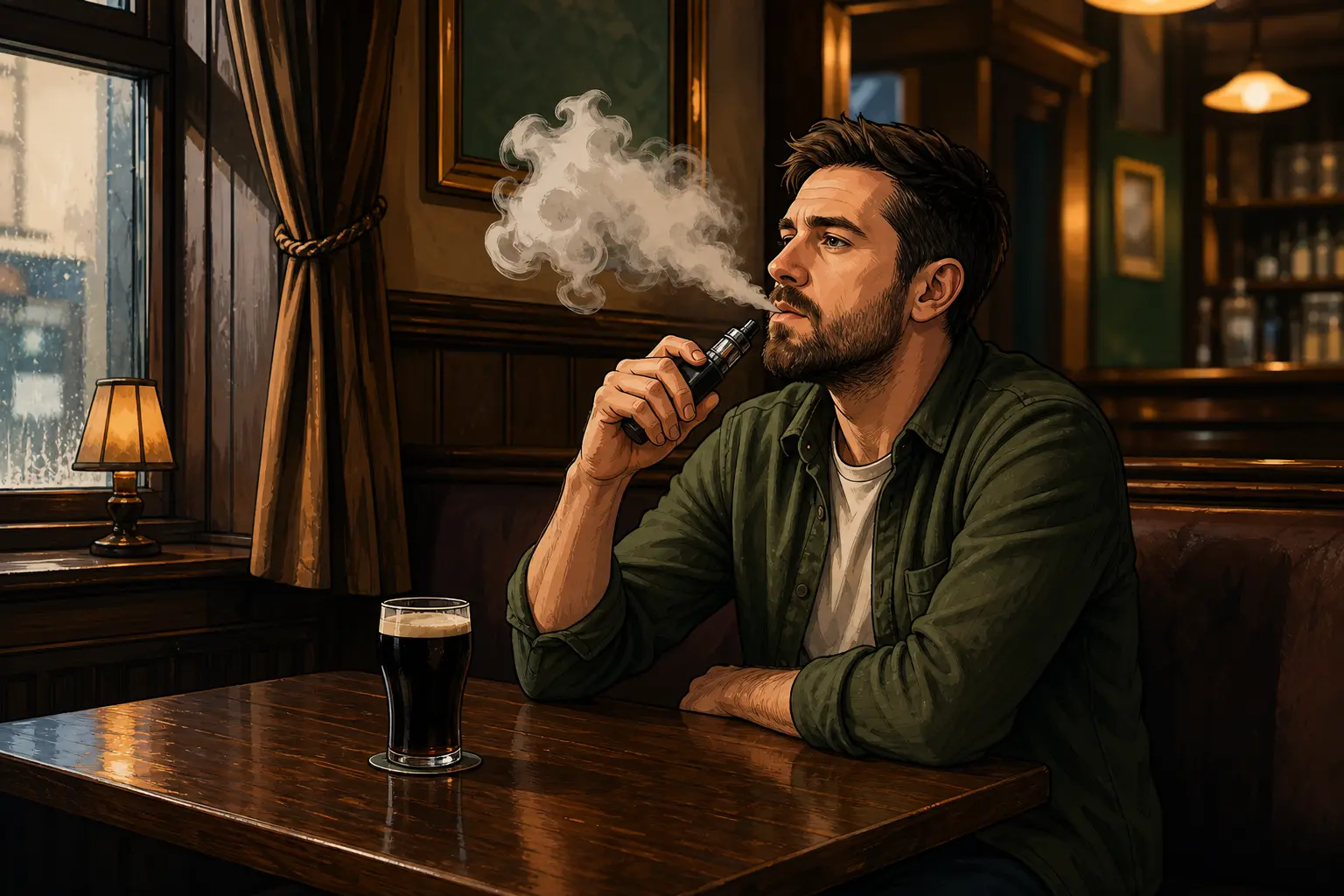
Hypnotherapy for vaping works with the habits and triggers behind the vape, not just the nicotine, which is often why it succeeds where patches and apps haven't.
A lot of people who come to me about vaping started off trying to quit cigarettes. The plan was never to vape for three, four, five years. It was meant to be a stepping stone, something to lean on for a few weeks while the cravings settled. Instead, the vape became the new habit, and for some people it feels harder to put down than the cigarettes ever were.
Part of that comes down to how vaping actually hooks you. There's the nicotine itself, which your body has learned to expect and crave. But there's also everything wrapped around it: the hand-to-mouth motion, the hit of flavour, reaching for it the second you feel stressed or bored or unsure what to do with your hands. Any quit method that only deals with the nicotine side is leaving half the problem untouched. That's really where hypnotherapy earns its place, not as some switch that turns off cravings overnight, but as a way of working through the subconscious routines and triggers that keep sending you back to the vape even when you've genuinely decided you want to stop.
Why Quitting Vaping Feels Harder Than People Expect
Here's the bit that catches people out. Vaping was never regulated or marketed as a long-term habit, so most folks assume it should be easy to drop. No tar, no ash, no smell lingering on your coat. It feels lighter than smoking, so surely quitting it is lighter too. In practice, I see the opposite more often than not.
Nicotine dependence is only one half of what you're dealing with. The other half is the behavioural loop that's built up around the device itself, the hand-to-mouth action, the hit of flavour, the little ritual of reaching for it when you're bored, stressed, or just filling a gap in the day. Patches and gum were designed to deal with the nicotine side. They do nothing for the habit side. That's a big reason people manage a few smoke-free days on nicotine replacement and still find themselves reaching for the vape out of pure muscle memory.
Vapes also slot into daily life in a way cigarettes often didn't. No need to step outside, no real smell, no awkward gap in a meeting. That constant accessibility means the habit can get woven into far more moments of your day than smoking ever was for a lot of people.
And underneath all of it, there's usually stress or anxiety doing quiet work. People don't always vape because they're craving nicotine in that moment. They vape to settle themselves. A few of the patterns I hear most from clients:
- Reaching for the vape automatically when a stressful email lands
- Using it to fill silence or awkward pauses in social situations
- Vaping before bed to switch the brain off after a busy day
- Using flavour almost like a treat, separate from any nicotine craving
- Picking it up during scrolling or screen time without even noticing
None of that is a willpower failure. It's a habit loop with an emotional driver attached, and that's exactly why approaches that only target the nicotine tend to stall out.
How Hypnotherapy Targets the Vaping Habit Differently
Let me be straight about what actually happens in a session, because there's a lot of mystery around hypnotherapy that doesn't help anyone. You're not put under and brought back with the vape erased from your mind. It's a guided state of relaxed focus, similar to the zoned-out feeling you get on a long drive or just before you fall asleep, where your subconscious is more open to new suggestions. From there, we work with the associations your mind has built up around vaping. Stress means a puff. Boredom means a puff. Getting in the car means reaching for the vape before you've even started the engine.
That's really the core difference. Patches and gum address the nicotine side of things. Hypnotherapy works on the automatic behaviour underneath it, the bit that fires off before you've consciously decided anything.
You still need to want this, at least somewhere underneath the frustration or the last few failed attempts. Hypnotherapy works best when there's some genuine motivation to build on, even if it's buried deep or tangled up with doubt. What it does is support that motivation and make the day-to-day resistance less of a battle, so you're not white-knuckling it through every craving.
Sessions usually involve talking through where your triggers actually sit, whether that's driving, socialising, a stressful work call, or just the quiet moments of boredom in the evening, and then using that relaxed state to start loosening the automatic link between the trigger and the vape. Some practitioners bring in EFT tapping alongside this too, which can help in the moment a craving or a flash of anxiety hits.
How many sessions you need depends on how long you've vaped, how deep the habit runs, and what's underneath it for you. I won't promise a single session fixes years of habit, because for most people it doesn't. If you want a clearer sense of how this plays out across a programme rather than one visit, it's worth looking at smoking cessation support designed around this kind of tailored approach.
Is Hypnotherapy for Vaping the Same as Hypnotherapy for Smoking?
Largely, yes, and that's by design. The core method, finding the trigger points where you reach for the device without thinking and working with your subconscious to loosen that automatic response, doesn't change much whether we're talking about a twenty-a-day smoker or someone glued to a vape pen. If you've seen hypnotherapy advertised mostly for cigarettes, that's just reflecting where the bigger market has been. The underlying approach transfers across.
But the detail does change, and it matters. Smokers typically light up at fairly defined moments: after a meal, on a work break, with a coffee. Vapers often puff in a kind of low-grade, constant grazing pattern, dozens of times a day, sitting at a desk, driving, half-watching telly. There's no real "occasion" to interrupt because the habit isn't built around occasions anymore. The sensory hooks differ too. A lot of vaping is tied up in flavour, in the hand-to-mouth fidgeting, in the hit of vapour, rather than the ritual of smoking itself. We work with that directly rather than assuming it behaves like a cigarette habit in disguise.
There's also a group I see more often now: people quitting vaping who never smoked a cigarette in their life. They picked it up socially in their twenties, maybe at a festival or round a friend's kitchen table, and now it's the thing they reach for through every stressful hour at work. There's no twenty-year smoking history to unpick, no memory of giving up cigarettes before. That's a genuinely different starting point, and it shapes which triggers we focus on first.
If you're looking at a smoking cessation practitioner for vaping, it's fair to ask them directly whether they've adapted their approach for it. Most experienced practitioners can, but you shouldn't have to assume.
What a Typical Hypnotherapy Journey to Quit Vaping Looks Like
You'll usually start with a consultation where we talk through your vaping history: when you started, how much you're using now, and the specific moments that trigger a reach for it. Stress at work, the first coffee of the day, driving, a pint with friends, whatever it is. This isn't small talk. It shapes everything that comes after, because the sessions get built around your actual patterns, not a generic script.
From there, the core sessions focus on interrupting the automatic behaviour and building your confidence that you can sit with a craving without acting on it. For a lot of people that's the real sticking point with vaping specifically. It's so easy and so constant that the habit runs almost entirely below conscious thought. Later sessions tend to shift toward relapse-proofing, working through the situations most likely to trip you up weeks or months down the line.
How many sessions you need isn't fixed. Someone vaping occasionally, mostly out of boredom, may find the habit loosens its grip sooner than someone going through several pods a week and using it as their main way of managing stress. That second group often needs more reinforcement to make it stick. There's no shame in either, and no honest practitioner can promise you an exact number before meeting you.
In the first few weeks, here's what realistic progress generally looks like:
- You notice yourself reaching for the vape before you actually pick it up, rather than realising ten minutes later
- Certain triggers become obvious to you for the first time, even ones you'd never clocked before
- Cravings still turn up occasionally, but they pass faster and feel less urgent
- You're building small new routines, like keeping your hands busy another way, that start to replace the old one
What's not realistic is expecting cravings to vanish overnight. Hypnotherapy works with your habits and thought patterns, not against biology entirely, so pairing it with practical changes helps a lot. Keeping vapes out of your car or bedroom, for instance, or finding something else for your hands during that habitual moment. Our page on common smoking triggers and how hypnotherapy helps you quit for good covers a lot of the same ground that applies just as much to vaping. If you want to talk through where you're at before committing to anything, a consultation call is usually the easiest first step.
Questions Worth Asking Before You Book a Session
Not every hypnotherapist who lists smoking cessation on their website has actually worked with vaping specifically, and the two aren't always interchangeable. Someone who's spent years helping twenty-a-day smokers may have only seen a handful of vaping clients, and the trigger patterns can look quite different. A vape is in someone's hand or pocket all day, used in places a cigarette never could be. Before you commit, it's fair to ask how much of their actual caseload has been vapers rather than smokers who happened to mention they'd switched at some point.
It's also worth asking how sessions are structured and what the plan is if cravings resurface a few weeks after you'd thought you were done. A practitioner who's honest with you will usually describe a small number of sessions rather than a single one, with some flexibility built in depending on how long you've vaped and how heavy the habit is. If they also use EFT or other techniques alongside hypnotherapy, ask why. A good answer will usually tie it back to dealing with the anxiety or restlessness that often shows up once the vape isn't there to reach for anymore.
Be wary of anyone guaranteeing you'll be fixed in one sitting. Vaping habits build up over years of small, automatic moments, and nobody can undo that reliably in sixty minutes.
- Have you worked with vapers specifically, not just cigarette smokers?
- How many sessions do you typically recommend, and why that number?
- What happens if cravings come back after the first few weeks?
- Do you use EFT or other techniques alongside hypnotherapy, and for what reason?
- What does follow-up support look like if I need it?
A practitioner confident in their process won't mind answering any of this. If anything, they'll be glad you asked.
Ready to Take the First Step Toward Being Vape-Free?
Reaching out at this point isn't giving up on yourself. If you've tried cutting down, swapping to a lower nicotine strength, or deleting the tracker app for the third time, that's not failure, that's information. It tells you the habit sits deeper than willpower can reach on its own, and that's exactly the layer hypnotherapy works with.
What I offer isn't a script run the same way for every client who walks in. Someone vaping through a stressful job in Waterford city has a different set of triggers to someone who picked it up after quitting cigarettes years ago, or a parent vaping on the sly in the car. Sessions get shaped around your actual day, your actual urges, not a generic recording you could've found on YouTube. And being able to sit across from someone locally, ask questions, come back for a follow-up if a trigger catches you off guard, tends to matter more than people expect when they're booking.
I'd also say don't think of hypnotherapy as the whole plan. It works best alongside EFT for the sharper, in-the-moment cravings, plus small changes to routine, what you do with your hands in the car, what you reach for after dinner. None of that needs to be perfect from day one.
If you're ready to look at what's actually driving the habit, you can read more about the approach on the smoking cessation page or just book a consultation and talk it through properly.
Frequently asked questions
Can you be hypnotized to quit vaping?
Yes, though "hypnotized" oversells what's happening. You're guided into a relaxed, focused state, similar to that drowsy feeling right before sleep, where your subconscious is more open to new suggestions. From there, the work focuses on the triggers behind your vaping, stress, boredom, driving, scrolling, rather than switching off cravings like a light. Most people stay fully aware the whole time.
What is the easiest way to stop vaping?
There isn't one universal easy route, because vaping habits differ so much from person to person. Some people genuinely do better going cold turkey. Others need something that addresses both the nicotine and the behavioural side, the hand-to-mouth motion, the flavour hit, the automatic reach for the vape during stress or screen time. Hypnotherapy tends to help most when the habit loop, not just the nicotine, is clearly running the show.
Is it possible to quit vaping cold turkey?
Some people manage it, usually when the habit hasn't woven itself too deeply into daily routines. But vapes slot into far more moments than cigarettes ever did, no need to step outside, no smell, no obvious break point, so the behavioural loop tends to be stronger. That's often why cold turkey works for a few days and then unravels at the first stressful email or boring evening.
What is the best vape quitting device?
Patches, gum and nicotine replacement devices only deal with half the problem, the chemical craving. They don't touch the ritual of reaching for the vape when you're stressed, bored, or filling a gap in your hands. That's why plenty of people manage smoke-free days on a device and still reach for the vape out of pure muscle memory. Hypnotherapy works alongside or instead of these tools by targeting that automatic behaviour directly.
How is hypnotherapy for vaping different from hypnotherapy for smoking?
The core method is the same, finding where you reach for the device without thinking and loosening that automatic link in a relaxed, focused state. What changes is the pattern itself. Smokers tend to light up at defined moments, after meals, on breaks. Vapers often puff constantly throughout the day with no clear occasion to interrupt, which shifts how the trigger work gets done in sessions.